Reports | Overview | Creative Practice | Theoretical Research
Thesis
ABSTRACT
This thesis interrogates two central arguments in relation to Feminism, through Practice as Research (PaR). Firstly, I propose a return to the body in Feminist theory as a way of reclaiming it from the violence of society and its participants – specifically from the societal violence of negative ‘body image’ and the physical violence of sexual assault and male-body bias. Secondly, I question the notion of a ‘shared experience’ of womanhood, investigating the ethics of this sentiment – which implies that universality undermines complex and crucial intersectionality – in contrast to the evidence that, for some women, this shared experience is part of the experience of womanhood.
The PaR element of this research includes reflections on performer journals and audience responses to a devised work-in-progress performance. The performance was devised using physical theatres to explore the themes of womanhood. The creative themes were derived from field research, in the form of a survey, which asked women to reflect on their relationship with their body.
I entered this research asking what physical theatres can offer Feminist narratives onstage but, as I began to explore phenomenology, my research evolved into a question of what it is to experience womanhood. Through an organic process of discovery, the research led to a return to a Feminism that considers the body as a central aspect of women’s experiences, and a reclamation of the body by women. This thesis will evaluate the theoretical and practical research elements, and analyse what they offer to this line of inquiry.
THESIS
Reports
Womanhood and the Body – Public Survey
The ‘Womanhood and the Body Survey Report’ details and analyses the responses of 52 women. The survey asks women about their relationship with their body and was designed to produce a sample of experiences for creative development.
My Body – Audience Survey
The ‘My Body Audience Survey Report’ relays and analyses the audience responses to the work-in-progress performance. This performance was a crucial part of the research due to the creative requirement of the degree. The responses inform my reflection upon PaR and the reception of the wider themes of womanhood.
My Body – Performer Journals
The ‘My Body Performer Journals’ are a transcription of the performers’ reflections upon the devising process. As with the audience responses, these journals are a vital part of my framework for interrogating the themes of my research. The performer journals also help to capture the value of participation regarding physical theatre practices and developing a more holistic understanding of our experiences as women.
Overview
This project is a dialogic approach to practice-as-research where the practice and research are constantly influencing each other. This explores the experience of womanhood through the body using physical theatres and a devising process. There are four key elements to the research: Practice as Research, Feminism, Phenomenology and devising with physical theatres. I will be evaluating the combination of these theoretical and practical approaches, interrogating their relevancy to the theme of womanhood and the body, and what might be gained by exploring them in conjunction.
This process included the circulation of a survey about womanhood and the body, which will be used as stimuli for devising. Performer reflective journals, my own notes and an audience survey from the final performance will all also be used to navigate my argument. Once the final report for the survey is complete, it will be shared here.
Creative Practice
This project became a reclamation of the body.
From the survey, four key themes emerged: weight and what it is to move through the world weighed, a rediscovery of bodyweight; the complexity of motherhood in it’s traps, expectations, responsibilities and wonder; the question of whether women are a community and womanhood is a shared experience, and posing that sentiment against the reality that some women feel that they have been raised to see other women as a threat; and the idea that women’s bodies don’t belong to them but to a society that expects us to look, behave and perform in a certain way, and to its men who, daily, subject women to nonconsensual physical contact, sexual harassment, assault and rape.
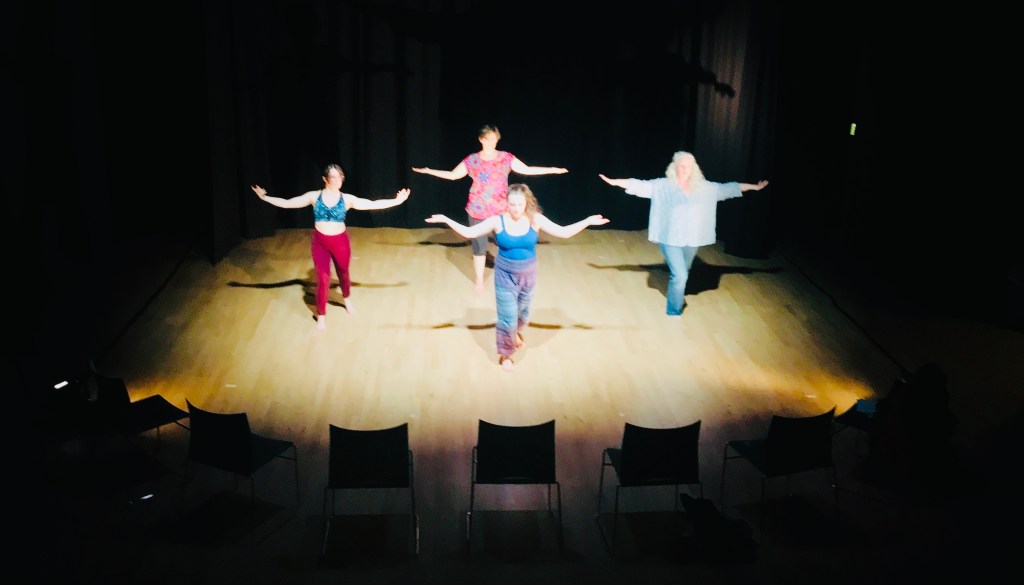
Of these four themes, the participants decided to work with the theme: my body doesn’t belong to me (or ‘my body’) due to the challenges the theme offered and because we all had some experience of sexual assault and reflected that it is an issue that is far from overcome.
We explored these themes using a devising process which centred the participant response and experience above the aesthetic and narrative. The process is informed by Butoh (an avant-garde Japanese performance art), the Leban-Bartenieff movement system (LBMS), and Frantic Assembly, and I will touch on each of their impacts respectively here.
Butoh emerged in Japan following the deep national trauma of Hiroshima. It is often described as being part of a movement to redefine Japanese identity following the catastrophe and in a new world post-World-War-Two which was more intercultural and globalised than before. The practice is one that is largely meditative and is spoken of by its practitioners in broad poetic language which is best understood and appreciated through practice. Butoh demands that its performers look and listen inwardly to practice the craft, which has two key strands. One is used on stock poses and ‘walks’, upon which context and imagery can be laid; the other is an improvisational Butoh, where performers develop their own movement vocabulary through exercises that encourage deep listening. Butoh is generally characterised by images of fully- or semi-naked Japanese men in white body paint and it is true that Butoh was performed and taught mostly by men in Europe and Japan following its international dissemination. Vangeline’s book: Butoh, Cradling the Empty Space remarks that sexual harassment and abuse were common place in the 60s and beyond as male teachers took advantage of their power over their female students. In light of this, working with Butoh in a collaborative women-led project feels important to both the project and the wider practice of Butoh.
LBMS is a movement lifestyle that is designed to make people think differently about and reconnect with their bodies. The book: Everybody is a Body by Studd and Cox acts as a handbook for anyone who would like to kindle a deeper and healthier connection with the body. They argue that there are health benefits to this kind of relationship and champion LBMS as a solution to the digital world where people generally are less and less connected to their bodies; a sentiment shared by Vangeline. LBMS asks for whole body awareness; considering all of the muscles, bones and joints that are involved in even simple movements. Studd and Cox argue that a better understanding of how we move will help us to listen to our bodies during the every day – at our desks, counters and workbenches.
Frantic Assembly don’t offer a philosophy or a rationale beyond creating energetic and aesthetically satisfying ensemble work. Their exercises are excellent tools in choreography: simple games that can be overlaid with imagery and purpose to create tone and narrative.
Theoretical Research
My creative practice is informed in large part by the reading research that I have undertaken for the degree. The dialogic approach I have taken has solidified my preference for this kind of working in the future. I believe that a strong theoretical foundation to creative practice can elevate the complexity of the performance product and ensures its relevancy to contemporary discussion in whichever field the practice is situated. The particular field in which this project is situated is at the heart of an intersection between phenomenology, Feminist performance, Practice-As-Research (PAR), and physical theatres. In my research, I have been continually surprised by the ease in which these elements can be applied to one another and by the ways in which this has already been initiated. For example: Vangeline’s Butoh: Cradling an Empty Space (2020) offers a Feminist and phenomenological approach to the Japanese avant-garde performance art; the Leban-Bartenieff movement system (LBMS) demands a rejection of Cartesian mind/body dualism, a value of phenomenology; and PAR offers phenomenological approaches to performance research.
Furthermore, as a testament to the advantages of working with theoretical and practical research simultaneously, as we drew towards a decision to work with the theme of ‘my body’ my thesis grew towards an argument for a theoretical reclamation of the body. I discovered that the post-structural Feminism of Judith Butler, who is highly regarded in the realm of performance theory, was, in my opinion, reductive to everyday sexism and the actual lived experience of women. Butler calls for a deconstruction of sex and the body, arguing that just as gender is a linguistic construct, so too are sex and the body. While this makes an important statement about how the physical body and physical sex should not be a factor upon which opportunities are denied, and violence is enacted, it also ignores the crucial physiological differenced between men, women and intersex individuals through which oppressions are carried out and trauma is formed. As with the creative practice, my theory called for a return to the body in Feminism but not in a way in which essentialist ideals allow women to continually be categorised as ‘other’ and in which intersex people are forgotten entirely. I call for a more nuanced approach to understanding the relationship between body, sex, and the deconstruction of the patriarchy.
 Laura Valerie Walker